What Are Routing Protocols in Computer Networks?
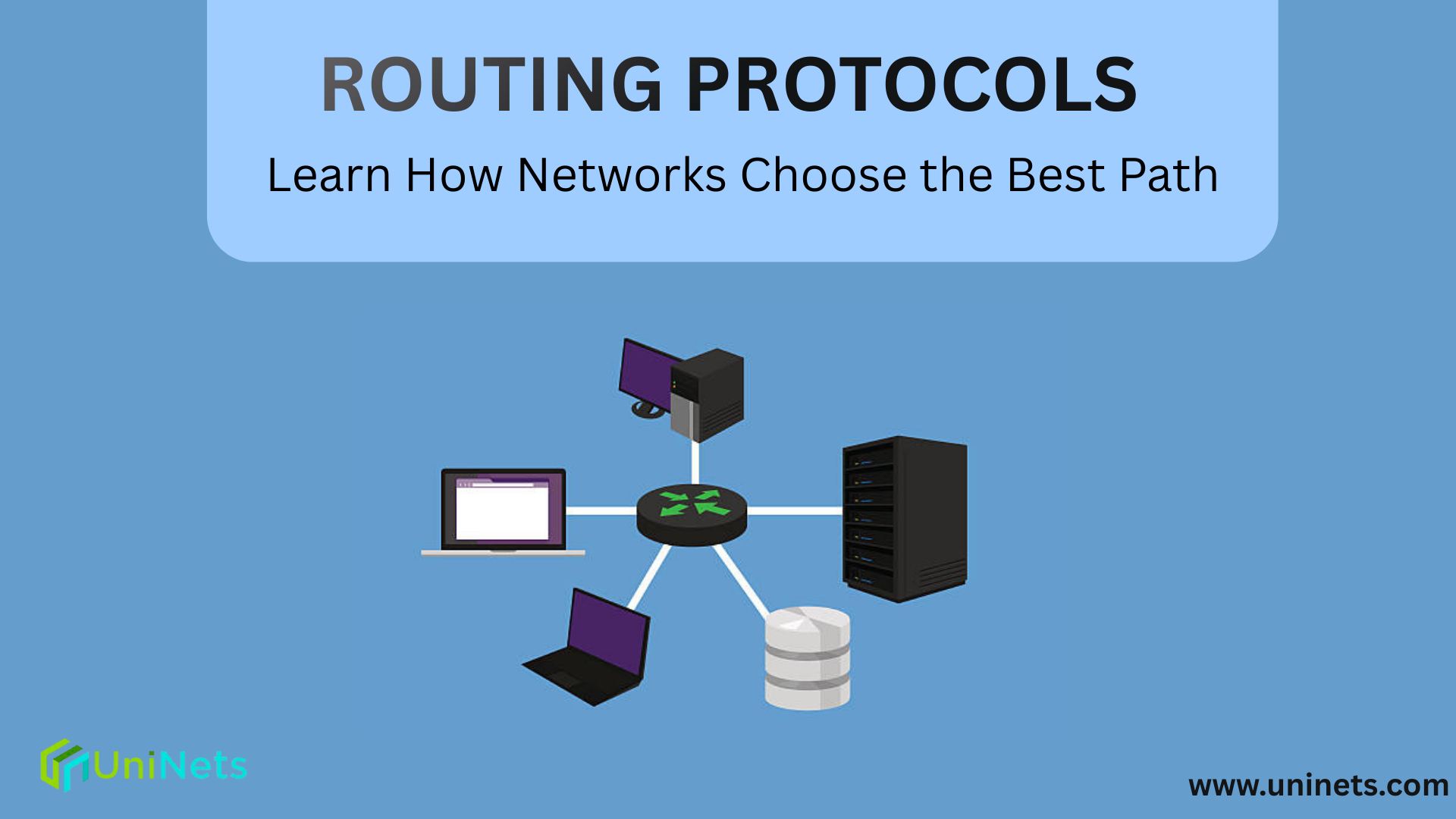
Routing protocols are the backbone of modern computer networks. They enable efficient data transfer by determining the best path for data packets to travel from source to destination. Understanding routing protocols in computer networks is essential for network engineers, IT professionals, and students pursuing certifications like CCNA.In this article, we will explore what routing protocols are, the types of routing protocols, and how they relate to switching technologies like STP (Spanning Tree Protocol).
If building expertise in routing and routing protocols is your goal, our networking courses are the right place to start.
What Are Routing Protocols?
Routing protocols are a set of rules used by routers to exchange information about network topology. They allow routers to dynamically adjust routes and ensure data reaches its intended destination efficiently. Without routing protocols, networks would require manual configuration of routes, which is impractical for large networks.A routing protocol essentially answers the question: “What is the best path for data to reach its destination?” By analyzing network information, it calculates the optimal route and updates routing tables automatically.
Why Are Routing Protocols Important?
Routing protocols are crucial for several reasons:
- Dynamic Route Updates: They automatically adjust routes when network changes occur, preventing downtime.
- Efficient Data Delivery: They determine the shortest or least-cost path for data transmission.
- Scalability: They allow networks to grow without manual configuration of every route.
- Network Redundancy: Routing protocols provide backup paths in case of link failures.
Types of Routing Protocols
Routing protocols in computer networks are broadly classified into several types based on their functionality and operational method.
Static vs Dynamic Routing
- Static Routing:
- Routes are manually configured by network administrators.
- Suitable for small networks with predictable paths.
- Does not adapt automatically to network changes.
- Dynamic Routing:
- Routers communicate with each other to discover network paths.
- Adjusts automatically to network changes.
- Common in large, complex networks.
Categories of Routing Protocols
Routing protocols are also categorized based on scope and algorithms:
Distance Vector Routing Protocols
- Example: RIP (Routing Information Protocol)
- Sends complete routing tables to neighbors periodically.
- Simple but slower convergence and limited scalability.
Link-State Routing Protocols
- Example: OSPF (Open Shortest Path First)
- Routers share topology information to build a complete map of the network.
- Fast convergence and scalable for large networks.
Hybrid Routing Protocols
- Example: EIGRP (Enhanced Interior Gateway Routing Protocol)
- Combines features of distance vector and link-state protocols.
- Efficient and widely used in enterprise networks.
Exterior Gateway Protocols (EGP)
- Example: BGP (Border Gateway Protocol)
- Used to exchange routing information between autonomous systems (e.g., different ISPs).
- Critical for internet routing.
How Routing Protocols Work
Routing protocols work by exchanging routing information between routers. Here’s a simplified workflow:
- Network Discovery: Routers detect directly connected networks.
- Route Advertisement: Routers share their routing tables with neighbors.
- Path Selection: The routing protocol calculates the best path based on metrics like hop count, bandwidth, or delay.
- Routing Table Update: The selected routes are stored in the router’s routing table for packet forwarding.
Different routing protocols use different metrics and algorithms to determine the most optimal path. For example, RIP uses hop count, while OSPF uses cost based on bandwidth.
Introduction to STP in Networking
While routing protocols operate at Layer 3 (Network Layer), switching protocols like STP (Spanning Tree Protocol) operate at Layer 2 (Data Link Layer). STP is crucial in preventing network loops in switched LANs.
What Is STP in Networking?
STP in networking is a protocol that ensures a loop-free topology in Ethernet networks. Loops can occur when multiple switches are connected redundantly. These loops may lead to:
- Broadcast storms
- MAC table instability
- Network congestion and outages
STP identifies redundant paths and blocks unnecessary links, allowing only one active path between switches.
How Spanning Tree Protocol Works
- Root Bridge Election: The switch with the lowest bridge ID becomes the root bridge.
- Path Cost Calculation: Each switch determines the shortest path to the root bridge.
- Port Roles Assignment: Ports are assigned roles such as Root Port, Designated Port, or Blocked Port.
- Loop Prevention: Redundant paths are blocked, ensuring a loop-free topology.
Variants of STP, like RSTP (Rapid Spanning Tree Protocol) and MSTP (Multiple Spanning Tree Protocol), offer faster convergence and better scalability.
Routing Protocols vs STP
It’s important to note the difference between routing protocols and STP:
| Feature | Routing Protocols | STP (Spanning Tree Protocol) |
|---|---|---|
| Layer | Layer 3 (Network) | Layer 2 (Data Link) |
| Purpose | Find optimal paths for data packets | Prevent switching loops in LANs |
| Example | RIP, OSPF, EIGRP, BGP | STP, RSTP, MSTP |
| Dynamic | Yes | Partially (Topology changes) |
Both routing protocols and STP are essential for network stability and efficiency, but they operate at different layers and solve different problems.
Advantages of Using Routing Protocols
- Automatic route updates for dynamic networks
- Reduces manual configuration errors
- Provides backup paths for fault tolerance
- Optimizes network performance
Conclusion
Routing protocols in computer networks are fundamental to the smooth operation of modern IT infrastructures. From small office networks to the global internet, these protocols ensure that data packets reach their destination efficiently. Combined with Layer 2 technologies like STP in networking, network engineers can design scalable, reliable, and loop-free networks.Understanding the types of routing protocols and the role of Spanning Tree Protocol is essential for anyone preparing for certifications like CCNA, or for professionals managing enterprise networks.